第7章 終章 ― 未完の完成、そして沈黙の祈り Chapter 7. Epilogue: Completion Through Incompleteness and the Prayer of Silence

English Summary
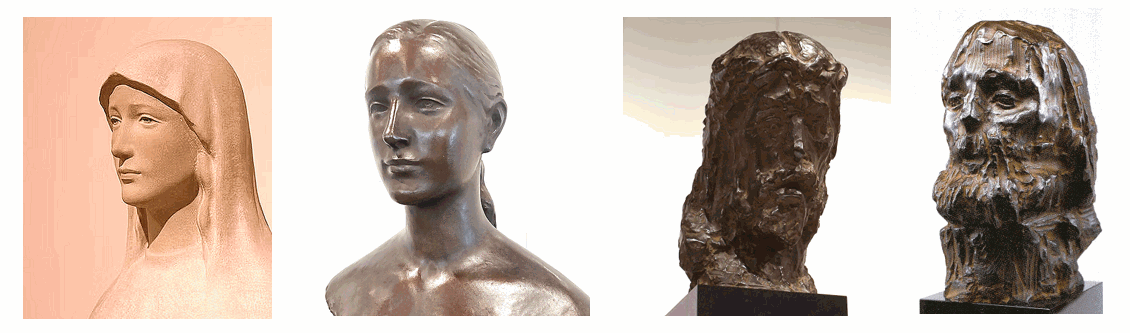
Following the sculptures of Yasutake Funakoshi is more than tracing the career of a sculptor; it is an exploration of the fundamental question of how human beings live and pray. Through works such as Father Damien, Hara Castle, Holy Woman, LOLA, Golgotha, and Golgotha II, Funakoshi consistently transformed sculpture into a record of the human soul.
His early works, created before his stroke, are marked by technical refinement and spiritual depth. Their formal completeness reflects a quiet dignity, where artistic perfection and prayer exist in harmony.
After losing the use of his right hand, however, Funakoshi's sculptures entered a new phase. His later works no longer pursue formal perfection but instead embrace incompleteness, asymmetry, and vulnerability. Yet these apparent imperfections reveal a deeper beauty. They preserve the sculptor's determination to continue creating despite physical limitations, allowing the act of sculpture itself to become an expression of life and faith.
Golgotha represents this struggle. Every movement of his left hand became an act of prayer, confession, and spiritual resistance. Rather than depicting religious certainty, the sculpture embodies a person wrestling with suffering while refusing to abandon faith.
In Golgotha II, created several years later, that struggle has disappeared. The dramatic tension gives way to remarkable balance and serenity. Prayer is no longer expressed through action but through presence itself. The work suggests not victory over suffering but complete acceptance of it. In this sense, it reaches an existential rather than merely artistic completion.
This interpretation is reinforced by the sculptor's son, Katsura Funakoshi, who remarked that he felt his father had to lose the use of his right hand in order to create Golgotha II. His observation suggests that the sculpture was not produced despite loss but because of it. Only through suffering could Funakoshi arrive at such profound equilibrium.
If Golgotha is prayer as struggle, then Golgotha II is prayer transformed into silence. Here, incompleteness is no longer a deficiency but a higher form of completion—an openness that invites the viewer into the work.
Throughout his life, Funakoshi sought to reveal the invisible presence of life hidden beneath visible form. The silence of Holy Woman, the gentle smile of LOLA, the anguish of Golgotha, and the serenity of Golgotha II trace not the evolution of technique but the maturation of the human spirit.
Now that I have reached nearly the same age Funakoshi was in his final years, his sculptures ask me a deeply personal question: What can I still create, and what can I still leave behind? Golgotha II offers no spoken answer. Instead, it responds through silence, suggesting that creation itself is a way of living, and that continuing to pray—whether through art or through life—is itself an affirmation of human dignity.
Funakoshi's sculpture was never an art devoted to perfect forms. It remained faithful to the truth that dwells within incompleteness. And ultimately, it is the viewer who completes what the sculptor intentionally leaves unfinished.
舟越保武の作品を辿ることは、一人の彫刻家の軌跡を追うことにとどまらず、「人間がいかに生き、いかに祈るか」という根源的な問いと向き合う営みである。「ダミアン神父像」「原の城」「聖女像」「LOLA」、そして「ゴルゴダ」。これらの作品を通して私が一貫して感じてきたのは、舟越の彫刻が常に魂の記録であったという事実である。
脳血栓で倒れる以前の舟越の作品は、いずれも完成度が高く、造形的にも精神的にも深く結実している。そこには技巧を誇示することのない静かな品位があり、形としての完成がそのまま祈りの深さと結びついている。
しかし、脳血栓以後、すなわち右手の自由を失い、左手による制作へと移行した後の作品は、まったく異なる位相を示し始める。
左手による制作において、舟越はもはや形の均整や完成度を目指していない。そこに現れるのは、「欠け」や「揺らぎ」、そして明確な「未完」である。だが私は、この未完成の中にこそ、完成を超えた真実の美が宿っていると感じてきた。それは、舟越が肉体の限界の中でなお祈りを形にしようとした、その生きる意志そのものが、作品に刻まれているからである。
左手で制作された「ゴルゴダ」は、その象徴的な作品である。この作品において、左手で粘土を切り刻み、掴み、押し出すという一挙手一投足は、彫刻の技法である以前に、祈りであり、告白であり、魂の闘争の痕跡であった。
そこには、神に向かって問い続ける人間の切実さがあり、人生を賭して信仰と向き合う姿が、痛切なまでに刻み込まれている。私はこの作品を、舟越保武にとっての「戦いとしての祈り」であったと受け止めてきた。
しかし、その数年後に制作された「ゴルゴダII」を前にしたとき、私は明らかに異なる印象を受けた。そこには、もはや闘争の身振りはない。切迫した抵抗も、告白の叫びも見られない。代わりに現れているのは、深すぎず浅すぎない彫り、出るべきものが出て、抑えるべきものが抑えられた凹凸の調和、そして静かな気品である。
「ゴルゴダI」は、技巧的完成の到達点ではない。むしろそれは、存在論的完成と呼ぶべき地点に立っている。ここでは、祈りはもはや行為ではなく、存在の状態そのものとなっている。舟越はこの作品において、自らの命を神に預けきった後の静けさ、すなわち沈黙としての信仰を形にしたのではないだろうか。日本語で言えば、「悟」という言葉が自然に重なってくるような境地である。
舟越の子息である船越桂は、「ゴルゴダII」について「この作品を作るために、父は右手の自由を失ったのではないかと思った」と語っている。この言葉は、単なる親子の感傷ではない。「ゴルゴダII」が、喪失の結果としてやむなく生まれた作品ではなく、この喪失を経なければ到達しえなかった必然の造形であることを、彫刻家として直感的に捉えた言葉である。そこには、奥へ行くべきものは奥へ行き、出るべきものは出尽くした、完全な均衡がある。
「ゴルゴダ」が問い続ける祈りであったとすれば、「ゴルゴダ」はその問いを生き切った後に訪れた沈黙である。ここにおいて、未完はもはや欠如ではない。それは、完成を超えた地点においてのみ可能となる、開かれた完成である。
舟越保武は生涯をかけて、「見える形の奥にある、見えない生命の気配」を彫ろうとした。その営みは信仰の造形であると同時に、人間存在そのものへの賛歌であった。
「聖女像」の沈黙、「LOLA」の微笑、「ゴルゴダ」の苦闘、そして「ゴルゴダII」の安らぎ。そこに貫かれているのは、技巧の深化ではなく、魂の成熟の軌跡である。
今、私自身が舟越と同じ年齢に達し、彼の晩年の姿を思うとき、心の奥で静かな問いが響く。「自分に残された時間で、私は何を創り、何を伝えることができるだろうか。」「ゴルゴダII」は、その問いに対して、声高な答えではなく、沈黙によって応えているように思える。
それは、「生きること」そのものが創造であり、「祈り続けること」そのものが人間の尊厳であるという、揺るぎない確信である。
舟越保武の彫刻は、完成を目指した芸術ではない。未完成の中にこそ宿る真実を、最後まで手放さなかった芸術である。
そしてその未完成を前にしたとき、完成へと至るのは、常に観る者自身なのだ。私にとって舟越の作品は、祈りを超えた生きる証であり、沈黙のうちに人間を信じ切ることの可能性を、今なお静かに示し続けている。
2026年6月30日更新